

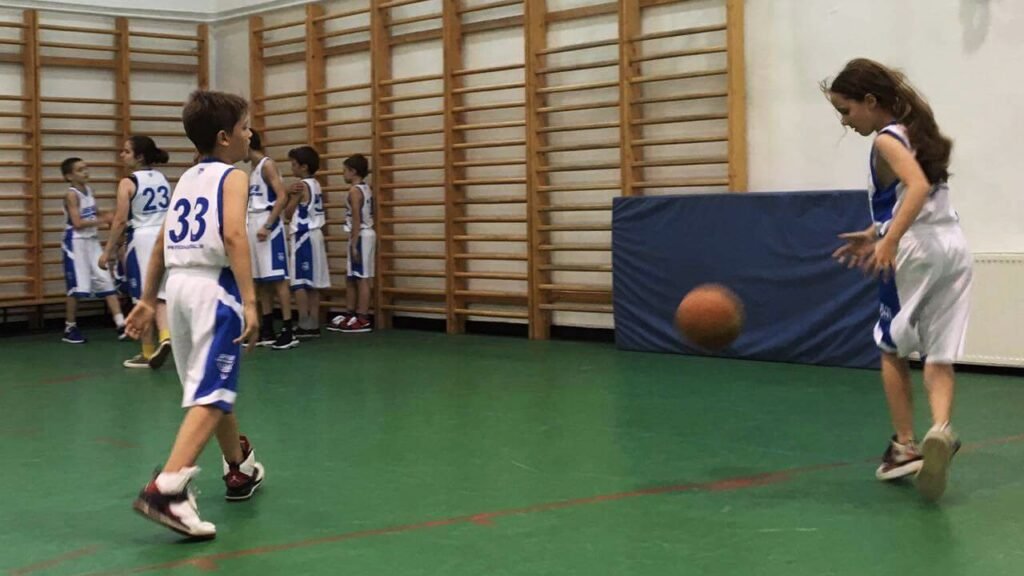
What is a pick-and-roll?
A pick-and-roll is a simple basketball play where one teammate (the screener) stands in the defender’s way to create space, while the ball-handler dribbles or passes the ball. After the screen, the screener usually moves toward the basket to be ready for a pass or rebound. For a quick definition, you can read the NBA glossary: Pick-and-roll definition.
How the pick-and-roll works on the court
On the court, the ball-handler approaches the screener, who plants the screen to impede the defender. The ball-handler then uses the screen to change direction, while the screener “rolls” toward the basket to receive a pass or open up space for a teammate shot. This action creates decision-making moments for both players and can help children learn timing, spacing, and teamwork.
Key terms you’ll hear
- Screen – the screener briefly blocks the defender, giving space for the ball-handler.
- Ball-handler – the player with the ball who uses the screen to move to a better shooting or passing angle.
- Screener – the teammate who sets the screen and then “rolls” to the basket or pops out for a shot.
- Roll – after setting the screen, the screener moves toward the basket to receive a pass.
- Spacing – the distance between players that makes the play effective and keeps routes open for others.
Basic steps of a simple pick-and-roll
- Ball-handler dribbles toward the top of the key or the side of the court.
- Screener plants their feet and sets a solid screen on the defender guarding the ball.
- Ball-handler uses the screen to drive in a new direction or pull up for a shot.
- Screener immediately moves toward the basket (the roll) or pops out for a mid-range shot depending on the defense.
- Ball-handler passes to the open teammate: the roller, a shooter, or drops the ball back to a wide-open option.
Tip for parents: keep explanations short and repeat key cues like “use the screen,” “roll to the basket,” and “look for the open teammate.”
Practice drills you can try with kids
These drills are designed for beginners and are friendly for parents to run in a park or driveway. Always start with a light ball and emphasize safety and fun.
- Screen and roll walk-through: Have one child be the ball-handler and another the screener. Practice the screen, then the roll, at a slow pace.
- Two-ball drill: Use two balls to practice timing—one for the ball-handler to drive and the second to pass if the defender helps.
- Pass-and-react: After rolling, the screener receives a pass and passes to a cone or target to simulate a defender’s movement.
- Communication game: Encourage calling out “screen,” “roll,” and “shoot” to build team dialogue.
Safety note: Make sure kids wear appropriate footwear and play on a soft, flat surface. Use lighter first passes and gradually increase speed as confidence grows.
Tips for parents coaching beginners
- Keep instructions short and positive. Praise effort and teamwork more than flashy moves.
- Focus on one or two cues at a time, then add more as your child understands the basics.
- Use simple demonstrations and repeat drills to build muscle memory.
- Make sessions short and fun to maintain interest and foster a love for the game.
Common mistakes and how to fix them
- Not setting a solid screen: ensure the screener plants feet apart and stays stationary for a moment to allow space.
- Rushing the play: encourage patience; the ball-handler should read the defender before making a move.
- Poor spacing: remind players to keep a safe distance so options stay open for everyone.
Roles and responsibilities at a glance
| Role | What they do |
|---|---|
| Ball-handler | Uses the screen to create space and decides to drive, pass, or shoot. |
| Screener | Sets the screen, then rolls to the basket or pops out for a shot. |
| Defender | Trys to fight over or under the screen and contest the pass or shot. |
For more kid-friendly basketball coaching ideas, you can visit official basketball resources and coaching guides (search for youth coaching tips and beginner drills).
Note: Understanding a pick-and-roll can be easier when you watch real games together. Look for moments where the screener frees space for the ball-handler, and discuss what options the players had in the moment.
Two-children-after-the-ball
two-children-after-the-ball
unsigned-document